On Wednesday of last week, as a mammoth snowstorm threatened to affect over one-hundred-million lives from Texas up through Montreal, I left the vacant shoppe early and made my trek home through knee-high drifts. Somehow, the impetus to brainstorm SCQ’s first Quarterly feature of 2011 hadn’t occurred to me until that walk, so forgive the belated nature of these reviews.
Unlike previous years where SCQ’s Winter Albums either presaged or basked in Canada’s coldest season, these mid-February choices catch me already wishing for spring. As such, let’s hope these records soundtrack the final weeks before an unexpected thaw takes these snow-mounds down the gutter for another eight months.
A side-note for those who’ve read this far: Skeleton Crew Quarterly was recently nominated for Best Canadian Music Website on CBC Radio 3. I have my suspicion as to who initially nominated me but I’m really grateful to everyone who has linked me to Facebook, Tweeted my URL at large, and/or contacted me with an exclamation mark or two. It’s an honour to be listed among such fine websites/blogs and I know it’s because of you – those who bother reading bottom paragraphs of Quarterly features – that I tip my hat to the most.
Of the multiple reasons Blonde Redhead’s Ottawa Bluesfest concert might spring to mind often, its therapeutic way of momentarily overlooking winter’s cruel wrath ranks somewhere around last. Sure, July’s dusk was an hour off, the sun was cresting over the river and a friend and I had just staked an ideal waterside plot of long-grass to drink beers and watch the band’s hazy set amid, but Penny Sparkle really doesn’t commiserate any of that. In fact, the very nature of Penny Sparkle amidst even the most AC-abused of summers feels slightly wrong.
As fragile as frost being thumbed from your windowpane, Penny Sparkle’s aesthetic elicits shivers at every turn. Arrangements focus on tight-lipped electronic beats that fizzle around intricate percussion and synths that, refreshingly, sound futuristic. Its production, courtesy of Van Rivers and the Subliminal Kid (the duo behind Fever Ray’s debut), invites icicles to grow upon such sparse terrain, and cloaks the band’s eighth LP in pale, delicate atmospheres. The strong-willed production-work no doubt has ramifications on Blonde Redhead’s songwriting but they’re of the ambiguous sort, more likely to reflect well due to the divide in opinions than suffer from them. And these songs are indeed flexible: the dubbed-out traces of ‘Will There Be Stars’ benefit from their far-off insinuations, as surely as a lurching bass keeps ‘Oslo’ lucid and wandering. Seldom does a song on Penny Sparkle permit instantly recognizable hooks, but ‘Here Sometimes’ and ‘Everything Is Wrong’, as exceptions to the rule, bolster the set from its introverted daydream. The rest are constituted of miniscule hooks in conjunction for a greater, album-crossing groove.
In a sleepy tapestry where even Kazu Makino’s vocals feel sidelined for gentle cooing, the downside becomes evident: such strict adherence to Van Rivers and the Subliminal Kid’s production encourages its homogeny. How one translates the threat of sameness will also decide its outcome; the record’s few overlong meditations, ‘Love Or Prison’ and the title track, survive on distant dance-rhythms that will appeal to electronic enthusiasts but likely outrage fans still clamoring for a return of Blonde Redhead’s noisy roots. For better or worse, Penny Sparkle isn’t an album to motivate action; it’s an album to collapse to, to drift in and out of conscious to, and to occasionally forget is even playing.
Funny, that soothing indifference to grab-me dynamics is about the only connection these songs have to that warm evening concert, in that our experience benefited from letting Blonde Redhead’s sly compositions sneak to the background. Penny Sparkle definitely has an escapist’s allure to it, and their liner-note on the CD sleeve (“Your Other World (Dream) Is Inside Here”) should be taken as an exciting forewarning.
I’m a witness to the changing fashions, I swear it. Let's rewind: 80s weren’t considered retro yet, not because it wasn’t old enough but because it wasn’t cool enough. Someone unearths an outdated instrument – say, a synth – and incorporates a single element of it into their modern-day composition. It catches on, and a month later half of college radio is swooning to a surge of retro-rock hybrids.
Now the apex of any musical trend occurs as it crosses into the mainstream, when the innovation of its grassroots approach meets the commercialism of mainstream waking up. Like Nirvana taking grunge to the major labels with Nevermind or, to a lesser extent, The Chemical Brothers fighting for mainstream recognition with Dig Your Own Hole; these represent the pinnacles of certain stylistic shifts shortly before the excitement subsides and everyone begins to move on. To avoid the harrowing task of choosing just one record to symbolize a summit for our near decade-long obsession with the 80s, I’ll say this: when bands stopped cherry-picking and genuinely tried to encompass the 80s, retro turned to pastiche.
That switch, which likely happened about two years ago, doesn’t deter records like Amulet from fighting the current and ultimately mining some of the scene’s final succulent fruits. Although ‘Triangle’ emits a palpable sense of here-we-go-again with thick drum-machine beats and laid-back synths, Teeel’s full-length debut snowballs with each track, challenging several of chill-wave’s elite contributions. ‘Sweet Camaro’ cruises a chic slice of oscillating night-air whereas ‘Galilean Moons’ takes a percussive stance with pounding beats and some smoggy vocals. Fittingly, the title track and finale smoothly integrates Amulet’s instrumental versus soft-vocal approach into a satisfying pop song, arguing that Jim Smith is as much a “traditional” songwriter as a beatsmith.
For Teeel’s brand of synth-pop, however, neither of those titles may be enough. The only proven way to maneuver chill-wave’s expectations so far is to abandon them; MillionYoung has become a band and honed his songwriting side, Toro Y Moi’s crafting his own sonic-vessel as we speak. As for Teeel, the climate’s still fine for him to inspect this trendy genre from all angles, tweaking what’s misshapen if not what’s old-hat, but let’s hope LP #2 doesn’t land on the exhausted side of our retro-pop timeline.
Thought up as a helpful descriptor, ambient-techno remains one of electronic music’s great oxymorons, combining a genre known for subduing sound-washes with one designed to arouse our kinetic impulses. The label’s so hard to characterize, it nearly undermines the potency, the thrill, of finding ambient-techno actually done right. ‘California Blue’, the lead cut off Tapage & Meander’s Etched In Salt, earns that tag outright with calm keys circling a restless IDM beat before finally fusing over some orchestral chasms. Its crunchy, sterile blizzard evokes Pantha du Prince’s Black Noise, but that’s just the first track; Etched In Salt transgresses ambient-techno, as well as IDM and break-core, to generate a devious but soulful electronic mixture.
Much of the record’s allure can be attributed to Tapage & Meander’s craft, which discards the accessible lures of four-by-four beats or treated guitar in favour of deft progressions and a purist’s sense of adventure. Look no further than ‘Plankton’ as an ideal diving point, where reflective keys meet a flurry of acid-squiggles and hard beats. Sometimes it’s hard to narrow down their influences (ie: are these guys bigger fans of Drukqs or AFX’s Analord series?), but the primary muse behind Etched In Salt remains pioneering electronica far removed from most noughties’ trends. And when I say “most”, I’m excluding the duo’s knack for cinematic progressions, like the strings that reinstate ‘Oceanographic’ with an emotional core or the contemplative low-end that lends ‘Hydrostatic Skeleton’ some gravity.
With 2011 as yet unwilling to unleash a ferocious, risk-taking electronica full-length, it’s doubly rewarding to glance back at Tapage & Meander’s underappreciated 2010 effort. Unlike ambient-techno, Etched In Salt isn’t always easy-listening but it’s a crash-course in why those sorts of subgenres never die.
There’s something irresistible and damned-near timeless about ‘Monster Of the Mirimichi’, the lead-track off of Confidence Lodge; how its unhurried guitar hook is pedestal’d by low-end bass falling out of speakers that, by its very rumble, should be hugging the wood-paneled floor of some Canadian basement. When its heaving chorus of stately electric distortion and piano takes hold, it almost begs the question: so who is Jon McKiel, anyway?
Let the Halifax-based musician’s promising young catalog guide that answer; having gathered a reputation for honest songwriting with 2008’s full-length The Nature Of Things, McKiel is currently finishing his long-awaited follow-up Tonka Warcloud. If that description still casts McKiel in a shroud of mystery, this between-records’ EP should adequately introduce his ever-changing sensibilities to newbies and long-time fans alike. Towing sludgy progressions of amp-blown electrics and muddy atmospherics into his narratives, McKiel’s everyman delivery pierces like sunrays through the fog, leading the charge for Confidence Lodge’s more delicate embellishments. From the minimalist piano tinkerings that boost the latent mood encased in ‘Rupert May 18’’s bass-heavy plodding to the mournful violin that somehow inspires hope beyond ‘Snow Owl’’s sparse guitar-plucking, McKiel’s arrangements feel as lived-in as a favourite old couch – collapse-ready with a lot of sponge-like stuffing swept beneath.
Despite its EP-appropriate length, Confidence Lodge rolls out a generous first-impression of McKiel’s work through expert sequencing and the absence of any throwaway tracks. Still catchy but grasping with some cantankerous terrain, McKiel’s songwriting is quickly becoming one of the East Coast’s most remarkable attractions. It's also worthy of the question: so when is Tonka Warcloud coming out?
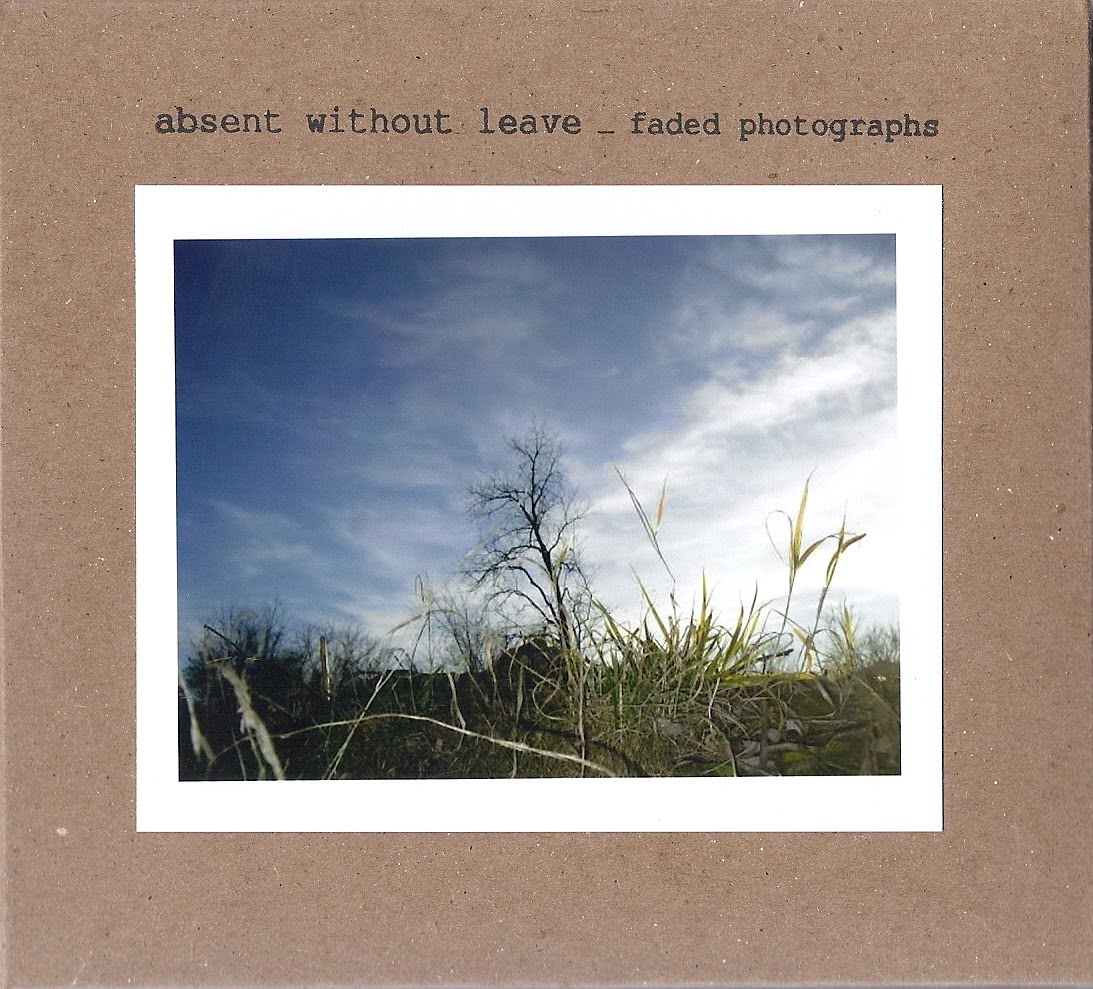
Anyone with a voracious hunger for soft-hued post-rock and net-label electronica has likely crossed George Mastrokostas’ Absent Without Leave project. It’s no wonder how ever-present his name is; forget being prolific, just check out how connected his instrumental moniker is. He has recorded for Chat Blanc, Duotone, the likely defunct Distant Noise Records, and a slew of others but you needn’t look further than the liner notes of Faded Photographs to get a sense of the company he keeps: Epic45, port-royal, millimetrik, and members of Hood and The Declining Winter to name but a few. If you’ve a passing interest in European label Make Mine Music, you know what a like-minded troupe Mastrokostas has gathered, one hell-bent on emotively pastoral guitar progressions polished within an aural inch of sterility.
And that’s how Faded Photographs plays out, with each track built one layer at a time until it has reached an orchestrated swoon. ‘How The Winter Comes’ accomplishes that dreamy trajectory with a sense of modesty, as does ‘Dreams and Hopes’, but the predictability lying at the heart of Mastrokostas’ centerpiece – that his acoustic guitar, his lead instrument, rarely deviates at all – begins to underwhelm over a course of songs varying between four and eight minutes in length. Sometimes one of these guitar figures has some percussive snap behind it, like both the enjoyable title track as well as ‘Balloons In the Sky’, but this strategy is doomed; without even a subtle shift away from such linear chord repetitions, these songs (bearing no distinct beginning or end) could technically loop onward forever. Accompanied by such a brimming assortment of guest-musicians only makes this compositional argument more pointed, as it’s hard to shake the idea that many of these familiar Epic45 and Declining Winter flourishes are simply fancying up bare-boned guitar melodies.
Electronic and post-rock fans smitten with the genres’ tendency to create emotional backdrops for personal reflections will eat Faded Photographs by the spoonful and, while I can appreciate why that is, Absent Without Leave doesn’t offer enough twists in the road for me to choose this pretty soundtrack over countless others.